Saturday, 8 July 2017

How to deal with trigger warnings without wrecking fiction

When I was a kid, the comic books I bought were published under the Comics Code Authority. That came about as a result of the Wertham horror comics scare of the 1950s. If you saw a book with the Code seal on it, you could be sure it wouldn't have swearing or excessive violence, or deal with sensitive issues like drug use.

Famously, Spider-Man went out for three issues without the CCA seal when Stan Lee insisted on running a story that featured drug addiction. I remember wondering what this meant. At any rate, the sky didn't fall in.

The Comics Code was designed to control the kinds of story kids were reading. Nowadays some grown-ups are concerned about encountering stories that will upset them. And so we hear about trigger warnings and content notes, the point of which are to warn the reader: "This novel may emotionally upset you with scenes of x, y or z."

The problem with a trigger warning is that pretty much all good stories are going to shake you up, the best ones quite radically and not at all gently, and being told the way they're going to do that is guaranteed to ruin the story. So how do we ensure that sensitive readers can steer clear of anything that might upset them while the rest of us dive into the unpredictable currents of hopefully disturbing literature?

How about a Novels Code Authority? In effect, in place of putting a trigger warning on any book that could upset some readers, mark the books that include no such content. Any novel published under the Novels Code would be certified free of emotional triggers, just like those Code-approved comics in the '50s and '60s. So anybody can safely read a book with the NCA seal on the cover. If it doesn't have the seal, that tells you it might contain triggers and you've got the option not to read it.

Monday, 3 July 2017

Tear jerkers


“Winning? Is that what you think it’s about? I’m not trying to win. I’m not doing this because I want to beat someone … or because I hate someone or because I want to blame someone. It’s not because it’s fun. God knows it’s not because it’s easy. It’s not even because it works because it hardly ever does. I do what I do because it’s right. Because it’s decent. And above all, it’s kind. It’s just that. Just kind. If I run away today, good people will die. If I stand and fight, some of them might live … maybe not many, maybe not for long. Hey, maybe there’s no point in any of this at all, but it’s the best I can do, and I will stand here doing it until it kills me. You’re going to die, too, someday. When will that be? Have you thought about it? What would you die for? Who I am is where I stand. Where I stand is where I fall.”

That, right there, is why I can't sit through an episode of Doctor Who anymore. Because it’s become one long self-indulgent pantomime, all speeches to the audience about how special the character's feelings are. The show is like one of those manufactured glimpses of a celebrity's life that Hello thrives on, endlessly repeated in an increasingly overwrought tone.

Think back to Jon Pertwee's Doctor. Desperate to escape from Earth, often at loggerheads with his companions, he stood for decency too. But the story wasn't slipped in as a subtext to his angst. And he never needed to get up and tell us what he was all about. His actions showed us that.

The sensibilities of YA fiction have taken over a lot of stories today. In effect the characters are adolescents, with everything that happens in the story being about them personally. There was a point to that when it just applied to Buffy and Spider-Man. They were teenagers. But now, God help us, so are James Bond and Superman and the crew of the Enterprise. So we're going to hear a lot more speeches about how hard it is to be a hero, a lot more tear-jerking farewells as the music swells. Moments in which the show can run out in front of the fans and tell them its manifesto. None of it rings true because we know, don't we, that real heroes don't talk about their heroism. But with this storytelling style, truth is the first casualty. Cordelia would get nowhere. Can't heave your heart into your mouth? There’s no place for you in Doctor Who then, love. The paradigm of the hero now is Goneril and Regan, posturing and speechifying to set the lips aquiver and bring big rolling soap-opera tears to the eyes.

It's populism. Yes, that again. Bad enough that it's wrecking politics, now it's taken root in storytelling too. Every season of Doctor Who is like a barrage of self-congratulatory Trump tweets. The show isn't SF drama anymore, it's one extended marketing campaign for itself. “Maybe there's no point in any of this at all – ” Moffat is surely talking there about having to write the same emotional beats month after month. Endless regenerations eventually hitting the Hayflick limit.

The fans just lap this stuff up, of course. The more a show refers to itself, the more they love it. But nothing can thrive on fan support alone. So I'm hoping we'll see a swing towards richer stories that build quality and a sense of character over time. The Whovian equivalent of Breaking Bad. Not flashy and full of quotable fan faves, but a story that quietly reveals itself to be a modern classic. It could still happen.
Monday, 8 May 2017

Kubo and the Two Strings


Last time I was over at Leo's he recommended some movies I needed to catch up on. One of them was Kubo and the Two Strings and -- wow. Just wow. I don't want to say anything spoilery (even that trailer gives away a little surprise that's waiting in the end credits) so I'll just urge you in the strongest possible terms to watch this asap. It packs in ten times the wit, charm, imagination and originality of the typical blockbuster SF/fantasy movie. Oh, and fans of my Blood Sword gamebooks will realize by the end why I especially cherish this story. A real delight.

Wednesday, 7 September 2016

Making characters compelling

1% inspiration, 99% perspiration. You know the deal. And it’s never truer than when you’re developing character designs. Here’s just a peek at the process we went through for Mirabilis...

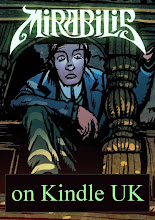
In very early versions of the comic, we started off with Jack in a more modern style of army uniform. As you can see (left), that really wasn’t working. Possibly it would have been more historically accurate in a story that nominally begins in 1901 but, as Emerson said, "a foolish consistency is the hobgoblin of little minds." The flamboyant hussar’s uniform that we eventually settled on is much more in keeping with Jack's romantic streak.

The very first pages of Mirabilis were a prototype pilot episode that Leo and I did (Nikos wasn’t on board yet) for The DFC’s dummy issue. The experience was… eye-opening. It wasn’t just the clothing that was wrong. Jack and Estelle needed to be way more attractive. So we opted to give Estelle a look that modern readers would find more relatable. She cuts her own hair – that was part of the character description from day one – and she does so with garden shears, so that gave us a legitimate excuse to avoid that off-putting Princess Leia hairstyle. Tom Fickling, son of David Fickling (the “DF” in DFC) put it succinctly: “Give her fit bird hair.”

Jack also looked rather too young and unathletic (even podgy) in the dummy episode. Partly that was to get the gig, because we had to please David Fickling and his initial brief was a comic for 7-10 year olds. At 10 I was reading Daredevil and Spider-Man, but that’s not how publishers see kids today. In fact the age of the strip was something that we and the Mezolith creators had to fight for all the time the The DFC was running.

Anyway, when we knew we had a green light for the series, Martin and Leo got to work on giving the characters a more dashing look. Martin even got out a camera and started snapping some action poses to give the comic panels a bit of vim. The dashing uniform he came up with shows off Jack’s heroic figure and incidentally shows that he is in the same regiment in which Coleridge briefly enlisted: the 15th (Elliott's) Royal Dragoons.His version of Estelle (bottom of this post) is a lot more engaging than the original "dowdy granny" look.

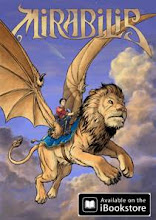
The striking poster image that Leo drew of Jack (top of this post) makes a great piece of concept art, although I don't think it will end up being an actual scene from the story because the giant lion is a touch too Narnia. But that doesn’t mean that he won’t be astride something with wings in the Spring book.

All this development work takes time, and even though it may seem blindingly obvious that the finished version is better, it isn't always that clear when you're groping your way through the maze of creative choices. Good creative development is a matter of trying things out and learning from your mistakes.

Apart from the character’s appearance, there are several storytelling tools that the writer can apply to make readers care about a character:
  • being resourceful 
  • being brave 
  • being clever (not the same as merely resourceful) 
  • doing a good deed ("save the cat") 
  •  being unfairly treated (“kill the cat”) 
  • standing up against unfairness or injustice 
  • doing something we can relate to - especially if funny, but can be as simple as cleaning teeth, having breakfast, if made into an interesting bit of business 
  • being in a relationship we can connect with - even two apparently despicable characters start to become relatable if we see a friendship forming between them
  • in a situation we recognize - stuck in the rain, needing a pee, late for a meeting, etc 
  • being interesting - this is how an audaciously badly-behaved, rude or even evil character can be made very compelling: what will they do next?
Next time you’re reading a story or watching a movie, take a look and see how often those tricks are used right from the start.

Wednesday, 24 August 2016

Indestructible!


"Hapless", "vengeful", "ruthless", "snapped"... That was the vocabulary of those British comics stories I grew up with. Kelly's Eye ran in the UK weekly comic Valiant. Tim Kelly stole the jeweled eye of the idol of the Inca god Zoltec, which turned out to be a handy accessory for an adventurer, seeing as how it made the wearer invulnerable.

Kids today might have iPhones and videogames, but they never got to thrill to the likes of Kelly's Eye and The Steel Claw and giant robot ape Mytek the Mighty. There was something in the UK drinking water back then, and those strips were masterpieces of focused fantasy storytelling that skated on the fine line between brilliant and barmy.


Many years after following the adventures of Tim Kelly, I got the job of writing stories about another indestructible man: Captain Scarlet. It wasn’t easy. Captain Scarlet got blown up, he just came back to life. The only time I managed to inject a bit of tension was when he was shot in the chest but people were in danger so he couldn't afford the luxury of dying and coming back to life again.

Tim Kelly's invulnerability was something quite different. Because it depended on him having hold of the Eye of Zoltec, there was plenty of drama to be squeezed from situations where he'd lost the Eye or had to give it to somebody else.

My enjoyment of those British comics of the '60s will never approach the all-consuming and utterly obsessive ardor I have for Marvel Comics of the time. But with hindsight I can see that they were little gems of imaginative fantasy that fully deserve that cherished place in my heart. Hope you like this glimpse into the past.

Saturday, 23 April 2016

"Not by me - D."

We have a little vignette here from The Fabulist (autumn 1915 issue) that is often attributed to Lord Dunsany, though it seems it was actually penned by a fellow named William Addison Dwiggins. Rumours attributing it to Dunsany must have begun early, because in his own copy of The Fabulist he apparently wrote: "Not by me. /D." I'm posting it here just to drive the stake into that particular myth - although it is undeniably a nice piece of writing, given extra puissance by the historical circumstances.


La Dernière Mobilisation
by W.A. Dwiggins

On the left the road comes up the hill out of a pool of mist; on the right it loses itself in the shadow of a wood. On the farther side of the highway a hedgerow, dusty in the moonlight, spreads an irregular border of black from the wood to the fog. Behind the hedgerow slender poplar trees, evenly spaced, rule off the distance with inky lines.

A movement stirs the mist at the bottom of the hill. A monotonous rhythm grows in the silence. The mist darkens, and from it there emerges a strange shadowy column that reaches slowly up the hill, moving in silence to the sombre and muffled beating of a drum. As it draws nearer the shadow becomes two files of marching men bearing between them a long dim burden.

The leaders advance into the moonlight. Each two men are carrying between them a pole, and from pole to pole have been slung planks making a continuous platform. But that which is heaped upon the platform is hidden with muddy blankets.

The uniforms of the men--of various sorts, indicating that they are from many commands--are in shreds and spotted with stains of mould and earth; their heads are bound in cloths so that their faces are covered. The single drummer at the side of the column carries slung from his shoulder the shell of a drum. No flag flies from the staff at the column's head, but the staff is held erect.

Slowly the head of the line advances to the shadow of the wood, touches it and is swallowed. The leaders, the bare flag-staff, the drummer disappear; but still from the shade is heard the muffled rhythm of the drum. Still the column comes out of the mist, still it climbs the hill and passes with its endless articulated burden. At last the rearmost couple disengages itself from the mist, ascends, and is swallowed by the shadow. There remain only the moonlight and the dusty hedgerow.

* * *
From the left the road runs from Belgium; to the right it crosses into France.

* * *
The dead were leaving their resting places in that lost land.

* * *

Thursday, 22 October 2015

Reading: the first line is your gatekeeper


You know about Sturgeon’s Law. ‘Ninety percent of science fiction is crap.’ Actually that’s the first law. The second law comes in with a (possibly) Pandoran note: ‘Ninety percent of everything is crap.’ I heard it was Ted Sturgeon’s wife who came up with that one. Or maybe I made it up. I suppose if you’re crotchety enough it may sound like consolation.

These days, the universal constants have changed. It’s so easy to publish a book that they may as well have automated the writing process. Faced with the evidence of Wattpad, we might have to adjust the Sturgeon Coefficient to more like ninety-nine percent.

The new books keep coming, thicker and faster every month, every week, and most aren’t going to be worth the time it takes to pick them up, but we still don’t have a formula to know which ones to fling aside. What future masterpieces might we miss amid the clamour? How can we pan for gold in all this muck? There is need, as Descartes said, of a method. So let me offer this…

A few years ago I was laid up in bed with a pole-axing cold. Wait, did I say a cold? This wasn’t just a cold; it was a veritable Fimbulwinter, a Plutonian hibernacle, a blistering absolute zero of a virus. I found it hard to stay awake more than thirty minutes at a stretch. Reading a novel was out of the question. I had a big anthology of short stories, but with a temperature of a hundred and one it was a struggle to get through the bad ones – and there were a lot of bad ones. So I went through the whole book reading only the first sentence of each. If that impressed, the story got marked as to-read.

Who passed? When I went back and looked at who’d earned a tick, it turned out to be the likes of Lawrence, Graves, Steinbeck, Forster – all justifying their reputation on the strength of a dozen words or so. Ah, you want show, not tell. All righty:
Few things have been more beautiful than my note book on the Deist Controversy as it fell downward through the waters of the Mediterranean. It dived, like a piece of black slate, but opened soon, disclosing leaves of pale green, which quivered into blue. Now it had vanished, now it was a piece of magical india-rubber stretching out to infinity, now it was a book again, but bigger than the book of all knowledge. It grew more fantastic as it reached the bottom, where a puff of sand welcomed it and obscured it from view. But it reappeared, quite sane though a little tremulous, lying decently open on its back, while unseen fingers fidgeted among its leaves.
I couldn’t bear not to give you that whole magnificent paragraph (by E.M. Forster by the way) but you only have to look at the first sentence. It’s enough on its own to tell you you’re in safe hands. And that’s my ‘lit-must’ test, if you will. Forget about evaluating the setting, genre, difficulty or even the story itself. If a writer can craft a fine opening line, they’re worthy of your trust. If only Mr and Mrs Sturgeon had known.