Thursday, 28 May 2015

MailOnline fails the Turing Test


The best of humanity are characterized by an open mind, insatiable curiosity, and a youthful - indeed, childlike - sense of wonder and delight. For these qualities, few surpass Lord Rees, the Astronomer Royal. If you get a chance to hear him talk, don't miss it. I was lucky enough to attend his lecture on "Real and Counterfactual Universes" a few years ago and the experience was like having a new section of my brain switched on.

Here he is writing in the Telegraph about artificial intelligence:
"By any definition of 'thinking', the amount and intensity that’s done by organic human-type brains will, in the far future, be utterly swamped by the cerebrations of AI. Moreover, the Earth’s biosphere in which organic life has symbiotically evolved is not a constraint for advanced AI. Indeed, it is far from optimal – interplanetary and interstellar space will be the preferred arena where robotic fabricators will have the grandest scope for construction, and where non-biological “brains” may develop insights as far beyond our imaginings as string theory is for a mouse."
And he concludes:
"Abstract thinking by biological brains has underpinned the emergence of all culture and science. But this activity – spanning tens of millennia at most – will be a brief precursor to the more powerful intellects of the inorganic post-human era. So, in the far future, it won’t be the minds of humans, but those of machines, that will most fully understand the cosmos."
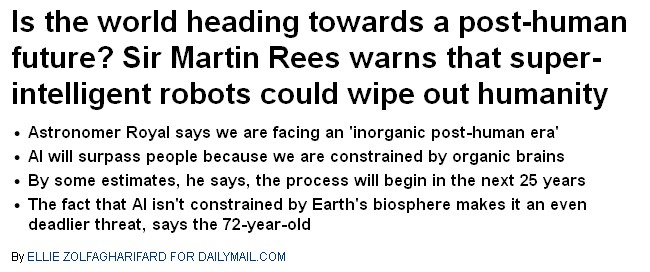
Anyway, it's a thoughtful and thought-provoking piece and you should read it in full. But why I mention it here is that, a few days after the Telegraph article was published, I saw this headline:


Good grief. How did we get from Lord Rees's article to that? It's like reporting on the crucifixion with the headline: "Jesus says human beings are all idiots who deserve hellfire". The clue is that this piece appeared in the Daily Mail. A friend once told me that the MailOnline website is the most popular news site in the world. If true, that explains a lot about the mess we're in today.

First, this isn't an original interview with Lord Rees. The Mail's "reporter" Ellie Zolfagharifard has simply quoted extensively from the Telegraph article and interposed her own interpretations. For example, look at Lord Rees's point above about advanced AI not being constrained to the tiny film of air and water around our own round piece of rock. "Interstellar space will be [their] preferred arena." Then look at the Mail's reading of that statement:
"The fact that AI isn't constrained by Earth's biosphere, makes it an even deadlier threat."
The extra comma is theirs, by the way. Continuing this epic fail in the art of précis:
"Sir Rees suggests that super-intelligent robots could be the last invention that humans ever make."
Quite apart from not being what he said at all, that should of course be "Sir Martin" if for some reason you don't want to give him his correct title as Baron Rees of Ludlow.

That use of "Sir Rees", though, at least accurately reflects the journalistic standards of the MailOnline. It's bad enough to cobble together your content by swiping from another newspaper, without then applying a scaremongering interpretation that is the direct opposite of what the original author was saying. MailOnline is the most popular news website in the world? Then hire some subs and some proper journalists, you cheapskates.

Tuesday, 26 May 2015

Loud & clear - but case not proven


I see a lot about “show don’t tell” on the Internet. Suddenly everybody has writing advice to offer, and the trouble is that most of it is wrong. Here’s an example of would-be show-not-tell from Age of Ultron - a movie that I’ve already been thoroughly unkind about but its carcass is still twitching and my blood is up, so here goes.

Spoilers ahead, by the way.

You know the scene I really liked? Thor puts Mjölnir on the coffee table and everybody has a go at lifting it. In the comics (I’m sure you know this; I’ll say it anyway) there’s an inscription on the side of the hammer: "Whosoever holds this hammer, if he be worthy, shall possess the power of Thor.”


Even before making the attempt, Tony Stark proves himself unworthy with his crack about reinstating jus primae noctis. And there’s a lovely character bit a little further on. You know the moment I mean. Anyway, nobody gets to wield the hammer and that’s that. Nice moment in between all the surround-sound action. Except, this isn’t just a character scene, it’s the set-up for something that comes later:


Now then. The Vision gives Thor his hammer back. (Yeah, I did mention spoilers, didn’t I.) You know why that's there. Because Joss Whedon has a dump truck full of characters to cram into this movie. Even worse, the Vision has been created in almost the exact same circumstances as Ultron, and he’s the reason everyone is running about and shouting jokes at each other. So how do we show that the Vision is worthy? Why, by having him pick up Thor’s hammer.

Except – that doesn’t show us, it tells us. When Cap budges the hammer slightly, that draws on many scenes from earlier movies where we’ve seen that he’s just about as decent a human being as you're ever going to meet. (Steve Rogers don't break no bad guys' necks.) There's another one of those scenes later in the movie, when Cap refuses to evacuate Laputa or whatever it's called and leave thousands to die. But the Vision – well sure, I know he’s worthy ‘cause I’ve read the comics. But in the context of this movie, all we see is that he is able to pick up an item that we’ve been told detects a character’s moral goodness. It’s second hand. We don’t see him do anything to earn it. We shouldn’t feel something just because Mjölnir tells us it’s so. Show us the thing itself, Joss, not the label.

There was no other way to do it, of course. The finale was roaring in like a juggernaut (but not the Juggernaut, which would have been fun) and we already know the whole team will have a big CGI fight with lots of jokes and then kill Ultron. So we just need to get rid of the annoying inner voice that’s saying, “What, you’re going to trust this red robot? Sorry, synthezoid. You just met him!” So it’s: look, he can pick up Thor’s hammer. So shut up and eat your popcorn.

As we left he cinema, my friend Rob Rackstraw said, “A movie like that is a hell of a thing to land safely.” And indeed it is. But a dog walking on its hind legs is also doing something pretty tricky, and there I’m with Dr Johnson.

Wednesday, 13 May 2015

A.I. candy


Age of Ultron, then. I know you don’t want spoilers. How would I spoil it, anyway? You already know the arc of the movie long before you see it, because it’s the arc demanded by the sheer weight of franchises and star contracts, by the simple need to toss bread to the international circus-goers, never mind selling an SUV-load of toys to their kids.

Scientists create an artificial intelligence and it’s benevolent and means only good for mankind. No? How about: scientists create an artificial intelligence, spurn it, and in doing so teach it only to respond with loveless rage and destruction? Uh-uh, for something as sophisticated as that you need an 18-year-old girl. The AI tries to take over the (yawn) world, then. Hilarity ensues. (No, really.)

Taking over the world starts by Ultron getting into the Internet. Possibly that explains why he also becomes artificially dumb, as whatever the software you’re equipped with, the entire Internet doesn’t have the processing power or complexity required to simulate one human brain. That could explain why he wastes time looking for the Pentagon’s nuclear missile launch codes, which even with staff cuts are hopefully not actually connected to the freakin' Internet. And don’t get me started on how a super-genius AI copes with global bandwidth.

OK, so lots of dumb decisions later, the inevitable big-as-Dumbo climactic battle. My main takeaways from this are, first, that robots are pretty fragile, especially the armour-plated variety. You hit them with anything hard, even the butt of a gun, and it’s likely a limb will fall off. Also, they become weaker in proportion to the number of robots in the army. Oh, and they are really, really stupid.

Maybe the problem is villains, period. We know that the world’s problems go so much deeper than one bad apple, so the villain just seems like a trivial and ineffectual pantomime bully. And villains’ dialogue always sucks. It’s like everyone involved knows that the villain is a lame carry-over from moustache-twirling landlords in old silent movies, doomed to talk a good fight till the final prole-pleasing punch. Next up in this never-ending Marvel merry-go-round: acromegalic alien beetroot Thanos. Oh god, kill me now, just don’t monologue like a silkily smooth thesp for five minutes before you do it.

Second takeway: if you’re putting a new superhero into a movie, you really need to give them powers that the viewer can easily grasp. You need it to be show not tell. Spider-Man shoots webs, climbs walls, and is strong and agile. Reed Richards can stretch. We don’t have to know exactly how strong the Hulk is, but we know he can bust stuff up and lift a really big weight. Being flesh rather than metal, no limb will ever fall off him. Well, maybe one tooth, if a building is dropped on his head.

But when we’re told that a character has powers of “telekinesis, telepathy, other psionic effects” then we are never going to have a clue what they can do. Whatever the plot requires, probably, just as long as they prance like a tit while doing it and a CGI geezer is on hand with his particle effects package in Autodesk Maya.

I said hilarity ensues, and I wasn’t kidding - unlike Joss, who never stops. Each character has a stock of quips. It soon feels relentless, as though Buffy Summers has taken over everyone’s heads and given them a snappy teen one-liner to see them through the gruelling times when the sticky tape holding the story together looks like giving way. The cinema audience laughed and laughed, but that doesn’t mean much. The same kind of people also gave a snigger when Nero set Christians on fire. I just thought: Joss, baby, don’t you want me to care? I think he was desperate. In between all the shouting and ‘splosions and the damned soulless CGI, he just clung to what he does well.

What he does well, he does very well. The scene when Cap tries to lift Thor’s hammer, the look on Thor’s face. That’s gold, a lovely character moment. A shame, actually, that it turned out to just be set-up for a payoff scene that came later. The payoff wasn’t nearly as good and in retrospect it cheapened the earlier scene. Oh well, it came towards the end – and then again, the same payoff with added joke, in case we missed it the first time.

And a nice scene between Clint Barton and his wife, gently ribbing him for failing to notice an Avengers office romance. (And by the way I’ve never seen any evidence in real life that women are so much better tuned to that stuff than men. Possibly they’re more interested in feelings, on average, unless that’s a myth too, but they’re certainly no better at intuiting them.) And here I was thinking Joss was really down on gender clichés after his remarks about that Jurassic Park teaser. Anyway, quibbles aside, he does that stuff well and the “Hawkeye” line was perfect.

And then – like hope flitting up from the bottom of the jar – there’s Mark Ruffalo. Oh, such brilliance in every expression, every line reading. He’s worth the price of admission just on his own. If only Joss could give us a Hulk movie. A Banner movie, I mean. Fewer characters, more time to develop a story, more character moments so that when the stomping and growling kicks off we might actually care. That would be worth your 15 bucks for sure.

Look, I honestly don’t have the time or the will to review the movie, but Sady Doyle did and I agree with much of what she said. Here it is if you’re interested, but I know it won't change anything.

Friday, 8 May 2015

Fantasy has to mean something


I was quite mean about Kazuo Ishiguro's The Buried Giant in my review a while back. Not that I suppose he cares a jot, but I've had a few qualms. No review can express the totality of what you feel about a book, and once I'd started criticizing Mr Ishiguro's storytelling craftsmanship the whole thing flew off in one direction and, while I did make mention of the elements I liked, maybe the overall tone doesn't give an accurate impression.

You can see the other side of the coin in my remarks on the Fabled Lands blog here. I like fantasy, but it has to serve a purpose; it can't just be escapism. Mr Ishiguro feels the same way, it seems, as he told The Guardian's books editor Claire Armitstead in this podcast interview. His example of the pixies and what they stand for is indeed a reminder of the powerful impact the book has in places. It still isn't a patch on Never Let Me Go, but a work of quality nonetheless. I won't even mention curates' eggs.

That interview is partly a riposte to Ursula K Le Guin's defence of fantasy in reply to an earlier interview with Kazuo Ishiguro in which she felt he was denigrating the genre. Gosh, what a set-to when authors start sniping over the barbed wire of genre boundaries. The debate about The Buried Giant obviously inflames fiercer passions than would ever be stirred up by reading it. Oh, there I go again. Don't take any notice of me. As I said before, you should judge for yourself.


As it happens, I sympathize with the point that Mr Ishiguro apparently wasn't making. Coming to a novel with a set of genre expectations means that you are locking out the overdetermination that (whether intended by the author or not) is open to you when reading a non-genre work. See for example "Can we really call Frankenstein science fiction?" on this blog a while back. Genre invites a literal interpretation - that dragon is unequivocally a dragon - whereas if you find the same book in the LitFic section of the bookstore then you'll likely approach it with an open mind.

I have nearly first-hand experience of this because of my wife Roz Morris's novel Lifeform Three, which tells the story of a robot who was built to serve mankind but finds himself wanting something more. The word robot is never used in the novel and, while I'm sure Roz wouldn't be ashamed of parallels with Ray Bradbury or even Isaac Asimov, that's not really where her book belongs. If you think I'm slighting genre by saying that, let me just direct your attention to the masthead of this blog.

Wednesday, 29 April 2015

Shoulda left it to the robots


You might find this review of Interstellar a bit spoilery. But at least it's over faster than the movie...

So, the Earth is dying because they can't figure out to use hydroponics. And Cowboy Farmer finds mysterious symbols in his ramshackle old house (= Signs, Close Encounters). And he says, "It's not a ghost. It's gravity." Though why shouldn't a ghost use symbols? Maybe it's the ghost of a mathematician. And he looks at a bunch of numbers in binary and he doesn't say, "WTF are these numbers?" Oh no. Instead he goes, "They're coordinates!" And they are the coordinates for a secret base within driving distance of his house. And he gets there and they say, "Oh yes, those are mysterious gravity things sent by these aliens who put this wormhole near Saturn" (2001). And nobody says, "Hang on, you're our best pilot and the gravity fairies told you the coordinates of NASA? So let's think about that for five seconds."

But you soon realize why nobody tries to have conversations like that, because one guy would say, "Could the arrival of the wormhole have anything to do with Earth's climate getting messed up?" but then another guy would say, "Faith is about reaching your hand up and knowing there will be something there to hold onto." And then they'll all nod and the first guy will be secretly thinking, "I'm locked in here with the crazy people." So they get into the ship and even though the robots seem to be the only intelligent ones, nobody pays any attention to them, probably because whenever you go, "I have a cold, maybe homeopathy and love and peace will cure it," they would say, "Are you absolutely sure you're the species that created us?"

OK, so off into space and more running about like a bunch of teenagers forced to go on a survival weekend (this crew could get a job on Prometheus, no trouble) and when they come back after 23 years in a gravity well, and Lady Scientist says, "Let's go to planet A" and Cowboy Pilot says, "Hang on, planet B is better but your boyfriend is on planet A, right?" she doesn't say, "Ya got me," she starts coming out with asinine twaddle about maybe that's the best criterion for judging stuff, and love is energy, like, innit, and it's the only thing that transcends time. (And also hate, lust, fart jokes, etc, in that case.) And the others don't say, "Oh, stop wriggling. We caught you out and you know it." No, they listen to her whole critically-failed Fast Talk roll as if it was a valid point. And then Dr Man (geddit?) turns out to be yet another famous actor, and he is mad and evil and tries to kill them, saying that nobody would go on risking their necks to save the whole human species, they'd only do it to specifically save their own family - even though history is full of examples of people putting the group first, and that is kind of the whole USP of homo sapiens. Obviously not a regular churchgoer, Man tries to kill everybody and take over the mission for HAL-like reasons, but everyone is saved thanks to the robots (what did I say about them?). This doesn't stop Cowboy Pilot from telling the robots they have to be sacrificed in a black hole. Lady Scientist doesn't come out with one of her love-is-energy speeches there, but she does at least query whether you should tell an intelligent, loyal being to sacrifice itself for your sake. Luckily Cowboy Pilot has an answer: "They have to do anything we tell them." (Hah, you fool, Aristotle, why did you waste all that time on that Ethics book, ya booby?) Anyway, Cowpoke sacrifices himself too, and he falls through the event horizon into Inception, where he gets a view of his daughter's bedroom as she's growing up and he can send her messages by pushing books and making the dust spell out binary messages. This would all be very confusing, but luckily one of the robots is on hand to explain absolutely everything to us (ya see? ya see?) and it turns out not to be God doing all this, but the gravity fairies are are, like, 5-dimensional people from the future. And they have just enough vestigial interest in the fate of the entire species (from which they evolved, let's not forget that) to give Cowboy Pilot limited access to one room on his farm over a 30-year peiod. Contacting humanity and giving us the answer to climate control, terraforming, wheat blight and wormhole tech would have been just too easy. And you can see the discussion (imagine this in 5 dimensions): "Shall we explain what they need to do to survive?" "Explanations are a bit too sciencey. Love is energy, dude." "Oh yeah. Just give this one guy a mystic experience, then. After all, we already know he must succeed or we wouldn't be here." "Point. Also, without the woo there's no movie. And we're shooting for M Night Shyamalan to direct."

No good points? Oh sure. I liked the explanation of why wormholes are spherical, the black hole FX, and the robots.

Wednesday, 1 April 2015

Nurse Twicely

The character of Nurse Twicely was unveiled to young readers – in fact, literally unwrapped – in A Little Lint and the Holy Spirit, a short novel by Mabel Barltrop, founder of the Panacea Society. The Hallivancy children find what they think is an Egyptian mummy: a figure swaddled in bandages in the lost luggage office at their local station. Their little dog Binky (later renamed Bad Dog by Nurse Twicely) gets hold of the end of the bandages and runs off, unwinding them to reveal a dozing Nurse Twicely.

“You naughty children,” she says. “I was having a nap after my journey and I suppose you put me in here like somebody’s lost steamer trunk?” When the children protest, she tells them never to talk back to an adult. Thus the Nurse Twicely books start as they go on, hammering home the suffocating manners of middle-class Edwardian England. But if that’s all the stories amounted to, they would not have been likely to seize the imagination of a generation of children. Mrs Barltrop was canny enough to include a hint of something fantastic as well:
“Why were you wrapped up in bandages?” said Annabel. “If you don’t mind me asking, miss.”
     “It’s not miss, it’s nurse,” said Nurse Twicely. “And they aren’t bandages like those horrid Gyptians who hounded Moses used to use. This is holy lint, and wrapping myself in it has given me as much get-up-and-go as a dozen tonics and fifty spoons of castor oil.”
     With that, she gathered up all the strips of fabric and smartly wrapped them into rolls, just as fast as cook could whip an egg. Binky gave a little growl as she tugged the last piece out of his mouth, but she wagged a short thick finger at him and he went as quiet as a wound-down clock, just like that. Then she packed roll after roll of bandages into her battered black bag. And there had been miles and miles of them, enough to stretch between every tree on the village green and still have enough to string the maypole, but she packed them all away in there like a conjurer doing a trick backwards.
     “Now then,” she said, snapping shut the big brass clasp and taking up her bag. “I can see four growing children, and somebody mentioned castor oil.” 
The first book was published in 1924 and was followed by Nurse Twicely Returns and A Third Spoonful of Nurse Twicely. Her return in the second book (she arrives wrapped in brown paper having been posted from Timbuktu where she had gone to help the missionaries) gives a reason for her name: “Because I will give naughty children a second chance, you see, but only Our Lord can give you three chances, and after that you can whistle all you like about your hot toes but there’ll be no help for it.”

At the end of the second book she climbs into her Prophecy Box and announces that she will only visit again when Shiloh (the Panacea Society’s female saviour) has come for watercress sandwiches on the lawn. This presented problems when the success of the series meant that Mrs Barltrop’s publishers demanded the third book for which she had contracted, so the stories in the new volume were explained away as some adventures from Nurse Twicely’s other two visits to the Hallivancy household that she had forgotten to mention earlier. (It is surprising that Mrs Barltrop was confounded by the need for consistency given that, in the course of the books, the Hallivancy children go from being orphans to having a mother whose eye colour changes twice and a father who is either dead, in India on business, or the local clergyman.)

Some elements are established in these three books that are present in Nurse Twicely’s later incarnations. She wears a white linen hat “shaped like a scone”, she is best friends with twenty-four bishops, she has an even lower opinion of little boys than she does of little girls, she likes cats but not dogs, and she takes her charges on whirlwind adventures around the world. In the books her adventures are rather pedestrian, despite the exotic locations and fanciful (or ignorant) depictions of native characters. Her motivation for these trips seems to be only to take the healing lint to sick children who have sent her postcards. Her relationship with the Hallivancy children remains that of an admonishing martinet enforcing “nice” manners. But all that was to change…

By 1930, in order to retain its charitable status, the Panacea Society was obliged to shed some of its assets. Mrs Barltrop sold the rights in the Nurse Twicely books to the West End impresario Norton Dudley. He apparently never read the books, buying the rights on the advice of his eight-year-old nephew, and promptly decided they were ripe for theatrical adaptation. For this purpose he engaged twin writers Jonas and Ruta Dauksa, Lithuanian Jews whose experimental plays had been strongly influenced by Artaud’s surrealistic Theatre of Cruelty. To Nurse Twicely’s adventures the Dauksas brought an element of uncontrolled fabulosity, much of it probably deriving from their poor command of English. A flavour of this may be detected in the different ways they have Nurse Twicely convey the children on adventures:
  • Setting sail in the boat at the bottom of the garden
  • Taking off in a flying lawnmower piloted by the gardener
  • Being carried along in the “plodding shed”
  • Sitting on deckchairs in the mist
  • Following the Rubric Footpath
  • Taking a “quirkular” route through a cornfield (“Why, it’s a maize.”)
  • Going out along the Dizza Pier, which sinks beneath the waves 
As the Dauksas’ style of humour proved disturbing, to say the least, older children were not infrequently removed from early performances in tears. Their younger brothers and sisters, however, having a less fixed idea of what reality ought to be, seem to have embraced what Jonas Dauksa called “the surrealiness” with enthusiasm. Nonetheless, with an eye to the box office, Norton Dudley decided that adding songs would make the play more accessible, to which end he hired Jonathan “Snapper” McFeely, a choreographer and street musician who had been a well-known figure in Soho pubs until his arrest in 1923 on indecency charges involving a tortoise.

McFeely composed a number of songs including “Jar-daft and Wobbly Wise”, “Poor Mr Butterhead”, “Black Magic and Fairycakes”, “Cardboardilly Boxadally”, “Socks for Tea”, “The Trouble with Tuesdays”, “Penguin Pie”, and “Riffraff and Sundry”. It should be no surprise to the reader to learn that McFeely had acquired a drug habit while in prison and fuelled his creative sessions with a cocktail of brandy, gin, betel leaf juice, and various narcotics.

The stage play enjoyed only moderate success and, as the generation that grew up with her turned to face the exigencies of the day, Nurse Twicely might have been forgotten. But in 1940 Norton Dudley, in an excess of patriotic zeal brought on by a health scare, donated the film rights to the Ministry of Information. “It shows the pride and ingenuity of the Semitic peoples in the face of adversity,” he declared, having forgotten the books ever existed or that Nurse Twicely, even in the Dauksas’ version, rarely allowed a scene to pass by without a dose of Biblical sanctimony.

That was swept away for the 1943 movie starring Arthur Askey. The script as rewritten by Marriott Edgar dispensed with Nurse Twicely’s smothering piety and made the whole story funnier and faster-paced, though at the expense of losing some of the fanciful charm the Dauksas had brought to it. Naturally Askey could not be repressed from improvising his trademark style of broad comedy patter with lines like, “Have you got the lint?” “Steady on, it’s just a touch of gout,” and the catchphrase, “That’ll do nicely, Twicely.” Some of the dialogue was deemed too risqué for wartime audiences, and ministry officials imposed a sound of crashing waves over the soundtrack as the Dizza Pier submerged:
NURSE: My old friend Dizzy? We called her Dizzy Peer on account of her bins. Like bottles, they were. Only you wouldn’t get a ha’pence if you took those back.
BISHOP: I didn’t say Dizzy. I said this is the Dizza Pier. It goes down, you see.
NURSE: So did Dizzy for two bob and a jam sandwich. 
The Rubric Footpath, which in the books was signposted with tendentious homilies and in the Dauksa play with koan-like riddles, here becomes the Rubberbrick Footpath, which Askey is able to bounce along with the help of some early wire work.

The episode in which Dolly Hallavancy is taken to the dentist illustrates the evolution of the concept. In Mrs Barltrop’s novel, Dolly is told to pull herself together, that the power of prayer is much more effective than any anaesthetic, and that Jesus endured much worse than toothache without complaint. In the play, the dentist has run out of laughing gas so he gives Dolly sneezing gas instead. It was left to Marriott Edgar to turn this into a full-blown comedy set-piece. In place of laughing gas, Dolly is offered a range of substitutes: “Sneezing gas, burping gas, hiccup gas. This one… oh, that just gives you gas.” Opting for blurting gas, Dolly then finds she cannot keep a secret or tell a lie, causing mayhem in the Hallavancy household until Nurse Twicely counteracts the outbreak of honesty with a gobstopper. Yet it’s possible that Mr Edgar may have drawn inspiration for this scene from the novel, where the character is known as the Gossiping Dentist and reveals all sorts of indiscretions. In the play this has become the Gossipy Dentures, an amusing puppet character who lives in a glass of water and generates chaos with his acerbic Loki-like pronouncements. (In the movie, the Gossipy Dentures appear only briefly and are voiced by Will Hay.)

Other characters that appear in various incarnations in either book, play, movie, or all three include the Garden Metro-gnome, Bad Dog and Wise Cat, and Dr Hugh, the twenty-fourth bishop who helps rescue the other twenty-three after they have fallen through the Prophecy Box into another world (an obvious lift from E Nesbit’s short story, “The Aunt and Amabel”).

After the war, with the books out of print and cinemas eager to replace British pictures with imported Hollywood features, the character of Nurse Twicely lapsed into obscurity. It’s possible that a young Spike Milligan may have come across the play while entertaining the troops in his artillery unit as part of the First Army in North Africa. Could Mabel Barltrop’s hectoring creation have influenced the anarchic comedy of the Goons? The truth, as ever, is unknowable.
Sunday, 29 March 2015

The Buried Giant: some treasure here, but more spadework required


There’s a tendency among many writers of literary fiction to opt for emotional coolness and ironic detachment, as though fearing that any hint of excitement in their storytelling would undermine the serious intent of the work. I don’t know where this notion came from. You can’t see Maugham or Greene or Forster having any truck with it. But the question is not where it started but whether that is the kind of literary writer that Kazuo Ishiguro is.

Adam Mars-Jones seems to think so. In his LRB review of The Buried Giant, he particularly takes Ishiguro to task for throwing away what ought to be a Fairbanks-style set-piece in a burning tower by allowing “nothing as vulgar as direct narration to give it the vitality of something that might be happening in front of our eyes”.

I’m not so sure about that particular scene. It could be that Ishiguro is reaching, not for the drama of the events, but the drama of the telling of the events. In the way he deploys the scene, we’re left in the dark for a while as to the fate that has befallen a major character. It’s how Conrad, say, might have chosen to tell it. The point is, though those events are not told in a way that plays up the excitement of the action itself, they nonetheless have dramatic effect. It works – just not as Mars-Jones or I might have preferred.

But there are other bits of the story that do not work at all, and make me think that Ishiguro either scorns, or is not craftsman enough to manage, the control of the reader’s expectations that is needed for a novelist to hold and enthral.

An example – and from here on beware of spoilers: Wistan and Sir Gawain are both supposedly charged with killing a dragon whose breath is causing people’s memories to slip away. Finally, approaching the dragon’s lair, Sir Gawain reveals that he has actually been protecting it for all these years. The two warriors walk up to the lair, chatting away, and we have plenty of time to see how this has to play out. Wistan and Gawain must fight, and because the book has a good way to go yet and there’d be no story if the dragon isn’t killed, we can see that Wistan will beat Gawain, and then he’ll slay the dragon. Almost sheepishly, Ishiguro then goes through those exact motions, apparently sensing that something he has done has defanged what ought to be a thrilling peripety, but not knowing how to fix it.

Unlike the burning tower, this isn’t a case of a scene that Ishiguro has made to work differently. As he tells it, the scene simply does not work. No story can grip if it fails to make the reader wonder what’s going to happen next. Here’s how he could have fixed it. Wistan and Gawain walk up to the lair. Wistan is still injured from the fight in the tower, Gawain is an old man. We wonder if even together they’ll be able to overcome the dragon. Then, just as they’re about to descend into the crater where the dragon waits, Gawain steps in front of Wistan and admits that he is sworn to protect it. Now that would be a moment of pure anagnorisis to make Aristotle cheer – and the reader would be left reeling. What? Sir Gawain’s on the dragon’s side? He’s about to fight Wistan? What is going to happen now?

See? Told like that we wouldn’t have time to predict the consequences. We’d be in the moment, struggling to draw breath. It would be – gosh – exciting. And it would work.

There are other places where Ishiguro struggles with the storyteller’s craft like it’s a broken deckchair. Fleeing from enemy soldiers through an underground labyrinth, Gawain and his companions come to a portcullis, which they lower – barring their own escape route – simply so that they can discuss (ie tell us about) the hell-hound that is said to dwell in the tunnels. In a movie the hound would at least turn out to be on the same side of the portcullis, though the shock would be soured by knowing the characters had done something dumb just for the sake of getting the plot into its next mooring. As it is, the hound turns up on the other side and we have to go through a lot of tedious mechanics about how they will raise the portcullis while ensuring that the hound doesn’t attack the two old people who are tasked with doing that. Everything plays out exactly as Ishiguro has just had his characters describe it, and then to top it all off we have to go through yet more nuts-n-bolts prose about getting the portcullis up having cut the rope earlier.

This verges on “he crossed the room, putting one foot in front of the other, until he reached the other side,” and it’s surely the job of the editor to point out to the poor dumb author that he has befuddled himself with foolish details and really ought to take a stab at getting the story firing on all cylinders rather than wandering around the side alleys of his narrative in an obsessive-compulsive daze.

Talking of obsessive-compulsive, I feel compelled to dwell on some quibbles. Ishiguro has a curiously imprecise control of authorial viewpoint that may possibly be deliberate, but in light of some of the fumbled set-pieces I’m inclined to think it’s just a failure of craft. For instance, lapsing into a personal narrative voice as he is inclined to do every hundred pages or so, he says, “Many were roundhouses not so far removed from the kind in which some of you, or perhaps your parents, were brought up.” Ah, so I am supposed to be a reader familiar with this world; these are events that occurred just a generation or two back. But not so fast – just a few lines further on he describes “a tall fence of tethered timber poles, their points sharpened like giant pencils” and we’re back in a modern mindset. Why not, “and a duckpond the shape of an iPad,” while you’re at it, Kazuo?

Maybe that skittering viewpoint is deliberate, but how about the sinews from a hacked-off arm being described as “entrails”? A “hollowed-out trunk” – when he means just a hollow trunk. “Comprised of” occurs a couple of times; didn’t this book have an editor? And there are several instances of constructions like, “with my wife and I hanging together on the rope” – these from characters whose grammar is otherwise solid enough.

And then this: the narrator tells us, “This door – it would have been a ‘proper’ door on wooden hinges – ” What? That voice, that “it would have been”, is how I might relate an anecdote. Pyrrhus being hit by the roof tile, for instance; something I know about but have no first-hand knowledge of, so I have to intuit details like, “it would have been a flowerpot-shaped cylindrical tile.” But everything else in The Buried Giant is related as if the narrator is there to see breath steaming on a cold morning, clothing flapping in a high wind. So why that one lapse into a removed viewpoint? If it’s technique rather than carelessness, it’s a technique that fails to have any useful effect.

Tom Holland in The Guardian gives Ishiguro the benefit of the doubt. "The gaps and seams," he says, "[...] are designed to show." But I say, goddamn it, an author should do the bloody work. Nabokov wanted Laura burned, and it was in not greatly more ramshackle a state than The Buried Giant. 

And yet – the book has something. A world in which memory is unreliable, a fantasy told without the pomp-rock bombast that’s typical of the genre, events recombining in oddly shifted permutations as in a dream, a quasi-allegorical exploration of love and loss – those are all interesting ideas. And Ishiguro has moments of great inventiveness that are well-served by his flatly unadorned style, as he talks of the ogres that emerge out of the mist or describes an attack by pixies on a boat caught in reeds. It often reads (and this probably is deliberate) like a translation of a classic saga, in that its brilliantly arresting images are recounted in the voice of an academic whose striving for accuracy sacrifices any of the original’s lyrical power. Fine, that's what Ishiguro set out to do and that, at least, he achieved. But me, I like to luxuriate in the poetry of beautiful language, and I kept thinking that if my accountant rewrote Malory or Beowulf she might end up with something a lot like this.

Look, here's the thing. All this carping is because I can see the outline of something great here. I just wish Ishiguro had chipped away the stone until he found it. Written by somebody like Alan Garner, The Buried Giant would be fabulous. As it is, throughout the book we continually run smack into quagmires of clumsy prose and expository specifics , with the result that it all reads like the extensive notes an author prepares before he or she gets stuck into writing the novel itself. It really is half brilliant and half incompetent – both "fascinating and moving" and yet "aimless and atomized", as Laura Miller described it in Salon - and that alone makes it almost unique among modern novels. Well, I say that, but I have yet to read the rest of Mr Ishiguro’s oeuvre.

If I haven't put you off reading the book (and I hope I haven't) then you might be interested in hearing Kazuo Ishiguro talk about it on this Guardian podcast.