Showing posts with label Fabled Lands. Show all posts

Saturday, 29 December 2012

Resolution

It's been a frustrating year. My interactive reworking of Frankenstein was published to critical acclaim and won a Kirkus star, and I have now prepared Epub3 and Kindle editions for release next year. My company Fabled Lands LLP entered a joint venture with a major international publisher to reissue a back catalogue of over thirty gamebook classics by me, Jamie Thomson, Oliver Johnson and Mark Smith, in both print and digital formats. And Dark Lord: The Early Years, created by me and Jamie Thomson and brilliantly written by Jamie, won the 2012 Roald Dahl humour prize.

So why the frustration? Because what matters most to me is Mirabilis. The other things are great too, but Jack's and Estelle's story is what is dearest to my heart. And nothing has been achieved on Mirabilis since June last year. I have all of Book 3 written (the first half of Spring), a bunch of standalone stories set in the Year of Wonders, and the outline for a one-special featuring a famous fantasy personality coping with the onslaught of the unreal in 1901. But those stories all need an artist, and both Martin and Leo are now far too busy on other projects (Martin's charming picture book The Gift and Leo's Pollock Theatre style Playrama cutouts for kids).

Eighteen months is quite long enough to let things slide. Too long. A little while back, Jason Arnopp (author of A Sincere Warning About The Entity in Your Home and Beast in the Basement - both brilliant, scary works of genius; go and buy them now, then come back and read on) tweeted that you should write as though you had twelve months to live. Wow. Some advice hits you like the word of God. What if 2013 was my last year? I need to get Mirabilis moving again and it's time to start recruiting the team and raising the money to do that. I've put up the provisional opening episode for Spring, "Long Time With Wadwoes", on Freado and I'll probably put it on DriveThru too. Now I'm looking at ways to get the whole thing restarted so that 2013 can be a true year of the comet!


Sunday, 31 October 2010

Drinkers of vein-wine

The king wanted a game of chess, but feared that his courtiers were letting him win. So he offered a boon to any man who could beat him. A man requested that if he won the king should reward him with one grain of wheat on the first square of the chessboard, two on the next, four on the next, and so on. It seemed a modest proposal. The king didn't discover until he lost that he could never hope to grant the boon, even by emptying every granary in the land.

Some authorities have extended the same principle to the spread of vampirism. If each vampire were to take just one victim a week, they argue, the number of vampires in the world should double and redouble until quite soon all of humanity would have joined the ranks of the undead. In less than the time from conception to birth, in fact.

Since this has obviously not happened, it follows that the condition of vampirism is not passed on quite so easily or so quickly as people imagine. Actually it is misleading to think of vampirism as though it were some kind of virus at all, and most of the misconceptions about it can be blamed on popular novels like Dracula.

Let us be clear about one thing: there are many kinds of vampire, and few of the vampires of history have had the stature of Count Dracula. Dracula became one of the undead, not by contracting an illness or being bitten by a bat, but by the sheer implacable force of his will. He was a man who simply would not submit to death. With energy born of relentless evil, he set about the task of building an empire of bloodthirsty dead in a manner that most vampires would never conceive of.

A megalomaniac, Dracula desired subjects to serve and worship him. But most vampires yearn for a solitary existence, and would prefer there to be no others of their kind in the world. This is the one and only reason that we are not overrun by the legions of undeath even now.

"O pity the dead that are dead, but cannot make the journey. Still they moan and beat against the silvery adamant walls of life's exclusive city."
What do all vampires have in common? It is much easier to list their differences: some drain life in the form of blood, some by stealing the breath or dreams of their sleeping prey, some (called succubi and incubi) by the enervating snare of their sexuality. Some are animated corpses, while others have no true material form but manifest themselves as extremely vivid and substantial ectoplasmic emanations. Some can pass for human, and may haunt the backstreets of our cities by night. Others, lacking the intelligence and charismatic force of their cousins, are barely more than monsters. The Feng P'o, or Northern Chinese Vampire, for example, has a manlike head but a giant apelike body covered in gore-soaked fur.

Some vampires, such as the Murony of Eastern Europe, can appear in the form of a black dog, cat or crow. Others are bound to a single hideous form - such as the Tzitzi Mimeh, or "Devil Women" of Ancient Mexico. They were the revenants of women who died in childbirth, and on nights of the new moon they would claw up out of their graves and hover around houses where there was a baby or a young child. If you caught a glimpse of their grinning, fleshless faces at the window it was a sure sign that plague would soon strike your household.

Like dragons, vampires have been known to all cultures of the world in one form or another. The Japanese are familiar with vampiric Gaki - souls whose karmic burden is so terrible that they are reborn as malevolent spirits with an unquenchable hunger. The Ketsu-Gaki is the residue of someone who was excessively cruel or violent when alive; it flits about the night like a giant macabre insect, seeking victims whose lifeblood can sustain it. The Yokushiki-Gaki is more like the vampires we are used to in the West. It can appear as an attractive man or woman, cultured and charming, and when it seduces its victims it drains them like a leech.

In Malaysia there are vampires known as Penangga Lan that appear as disembodied heads trailing a mass of bloody entrails as they float through the air. The Langsuir of the Phillipines is a female vampire that punctures a hole in the back of its prey's neck in order to drink the blood; it can hunt in the form of a glittering white owl or use its beauty to ensnare a victim. From Greece and Turkey come reports of invisible vampires called Opir, who interbreed with mortals and who can only be seen and slain by their own deformed offspring. The aborigines of Australia not so long ago lived in terror of a batlike demon called the Garakan, while 19th Century Cairo was haunted by a vampire that tore out its lovers' tongues with a deadly kiss and then drank the spurting blood that pumped from the wound.

"Leave the flesh to the fate it was fit for."
In the midst of all these tales of horror there are a few crumbs of hope. Accounts of vampires are almost unanimous in affirming that a vampire cannot enter a household unless invited to do so by someone who lives there. (This perhaps explains why vampires have developed abilities of charm, command and persuasion.) Most vampires, in Europe at least, are driven back by garlic. This must be wild garlic - "sorcerer's garlic" - and it is the small white flowers that the vampire abhors. Garlic cloves give no protection, and regular consumption of garlic is more likely to drive off vampire hunters than the demons themselves.

Mirrors can give some warning when a vampire is present, as it is said that vampires do not cast a reflection. Beware, though: only a mirror of polished silver has this effect, and it only works against Undead of the ethereal variety. A vampire with a true physical existence (a walking cadaver, that is) will still cast a reflection. A vampire of this type may also be immune to that other traditional defense, sunlight. Even Dracula, who was more probably a vampire of the ghostly sort with the ability to manifest in a variety of forms, was able to go about in broad daylight - though it was only at night that he was able to utilize all of his uncanny supernatural powers. Some sources claim that a vampire cannot cross running water, but it is inadvisable to rely on this. It derives from an old folk-belief that running water, particularly southwards running water, is holy and thus impervious to evil spirits. Possibly only a rural vampire who shares this belief will be affected by it.

Faith is the principal line of defense against the Undead. The crucifix, being the most potent symbol of Christ as well as an ancient talisman of the division between life and death, is anathema to any vampire. The vampire's personal religious conviction is immaterial: as a soulless monster, it abhors the sight of the cross and must retreat from it. In the hands of a sufficiently pure and pious individual, the cross can cause a lesser vampire to dissipate altogether. A more powerful vampire is simply "turned" - forced to depart.

Other religions also have some power over vampires. The Gaki of Japan are the result of a glitch during the proper course of reincarnation, the cycle of death and rebirth which Buddhists believe all things are subject to. They can usually be laid to rest by applying the Buddhist segaki rite for the dead, although first the Gaki's grave must be found. Islamic vampires tremble at the name of Allah and can sometimes be led to renounce their evil ways by reference to the Quran. Jewish vampires are motivated by demonic spirits. They are the forerunners of the traditional European vampire and are more powerful and purposefully malign than the vampires of the Slavic countries. Fortunately the elders of the Jewish church have access to magic via the cabbala, and are better equipped to deal with demons than Christian priests are. In former times Chinese vampires were generally courteous and quite conscious of their wickedness, needing only an appeal to Confucian ethics to point out the weakness in their character and impel them to self-destruction. This tendency has declined since the Cultural Revolution, however, and Chinese vampires are now among the most intractable and deadly in the world.

"What disturbs our blood is but its longing for the tomb."
Once a vampire has been rendered helpless by whatever means, it must be destroyed immediately and without pity. The creature will use all its wiles to escape this fate: threatening, conjuring images, pretending remorse, trying to hypnotize its captors, and so forth. Ignore any such ruse - even a show of hesitation is sometimes enough to dispel whatever advantage you have achieved.

First a sharp implement should be driven through the creature's heart. Some authorities insist on a stake of hawthorn wood (because of the hawthorn tree that Joseph of Arimathea caused to sprout at Glastonbury), but it seems that Harker and Morris were able to dispatch Count Dracula with a kukri and a bowie-knife. If the vampire is of the walking corpse variety, the demonic spirit possessing it will instantly be driven out and the body will attain its proper age and state of decomposition. If it is a vampiric ghost, its visible form will disband and you must then seek out its grave and repeat the procedure on its disinterred remains.

Once the corpse is impaled, any appropriate rites for the dead should be given while at the same time cutting off the head and - as an added precaution - the hands and feet. Various other measures can be taken at this point such as sprinkling holy water or wafer over the body. Lastly the remains should be burnt to ashes and those ashes either scattered over water or hallowed ground or else buried at a crossroads. If there is no crossroads nearby, a T-junction will do.

Van Helsing considers that no technique for dealing with and destroying vampires can be considered one hundred percent effective. These creatures assuredly are the most devious and mighty of all Earthbound unholy things, and the fate they threaten their victims with is nothing less than the damnation of the immortal soul. The best advice is not "Approach with caution", it is "Do not approach at all."

* * *

Hope you enjoyed our special Halloween feature. The story of how it came to be written is over on the Fabled Lands blog, along with the short story that eventually became the basis for A Dying Trade. The illustration is by Russ Nicholson - go and check out his blog too because I'll bet he has something really tasty for tonight's festivities.

Monday, 9 August 2010

iPad news

No, not that iPad news. You'll have to hang on just a short while longer before we can bring you that. But while you're waiting to hear when the green comet is going to light up the App Store (soon, very soon) you might be interested in this report on Russ Nicholson's blog about the Fabled Lands game coming on iPad.

Fabled Lands was a series of connected swords-n-sorcery gamebooks I wrote with Jamie Thomson back in the 1990s. We don't usually cover that branch of the fantasy family tree around here. We're more into Dunsany and John Collier than Feist and Gemmell. But if you allow that the point of contact between those two extremes might be authors like Moorcock, Whitbourn, Tim Powers and Susanna Clarke then possibly there's a line of connection to be drawn.

And while I'm on the subject of fantasy, there are interesting stirrings of something fresh in the genre, in the form of a movement called the New Weird. Okay, not really all that fresh (other than in name) as you can trace it back to In Viriconium, indeed to Gormenghast, and thence back to Gothic literature. But that dark, spicy strain of fantasy is enjoying a bit of a renewal of late. I like it because it brings a little of SF's progressiveness and naturalism to a genre that is often stilted, twee, contemptibly conservative, and slavishly adherent to familiar tropes. (Although if you like all those elven council sagas don't let me put you off.) The New Weird, though, is a bit grungier and rather more likely to shake your world-view than reinforce it. If it sounds like it might be your tincture of opium, you could do worse than start with this manifesto by Paul Charles Smith.

None of which applies to Fabled Lands, I hasten to add, which is unreconstructed FRP-style adventure as it existed in the heyday of gamebooks. Coming soon to an iPad near you.

Monday, 29 March 2010

Fantasy isn't meant to be cosy

Mirabilis never had any of that sword-n-sorcery stuff. It was our deliberate policy. Mirabilis was about what happened if the imagination spilled over into everyday reality, indeed into the stuffy keep-the-lid-on reality of Victorian/Edwardian life. (Which is the same theme as Mary Poppins, now I come to think about it, although perhaps our take on it was a little different.)

Swords and sorcery fiction, pulpy fun though it may be, is not generally about letting the imagination off the leash. More usually, in fact, it turns out to be the most conservative of all genres, a concrete branch of fiction with carefully defined rules, more about cosiness and reassuring formalism than the often disturbing and elusive nature of true fantasy.

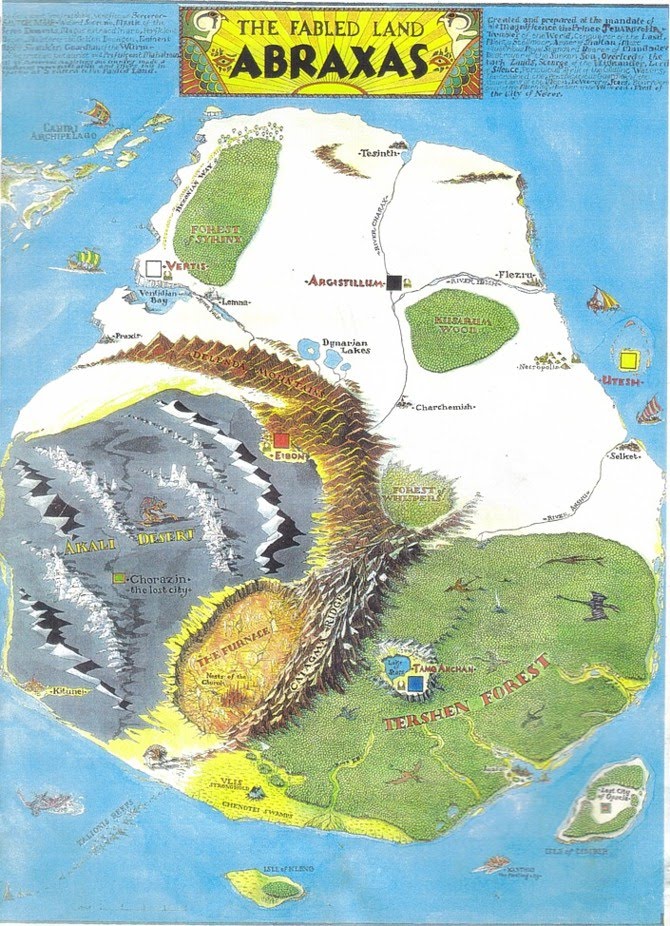
The only reason I feel justified in plugging the world of Abraxas on this blog is that it belongs to a branch of swords-&-sorcery that has so long fallen into disuse that it has all but regenerated itself. I refer to science fantasy, the ancient-world-flavored genre of swordplay, magic and vril-powered technology once popularized by the likes of Clark Ashton Smith, Leigh Brackett, Robert E Howard, L Sprague de Camp, Fritz Leiber Jr and Edmond Hamiliton. Devised by me and Jamie Thomson, Abraxas is the kind of swashbuckling fantasy world that kicks elves off the side of air cars and would shoot hobbits in the face with an ionic blaster (3 charges remaining).

No, it's not Tolkien nor urban/dark fantasy and it's not steampunk neither. Oh, I can't tell you how bored I am by elves and hobbits and their ilk, whether cybernetically enhanced and palely nightclubbing or prancing around dank dungeons looking for orcs to twang arrows at. Unplug the jukebox, try another flavor. In the Burgess Shale of pulp literary history, there were a few more fantasy genres than that and the blood stirred fast and hot in their veins. If you're interested to find out more, pop over to the Fabled Lands blog.

Thursday, 25 March 2010

Bernie Wrightson's first gig

It was always Marvel for me, never DC. Well, I say that, but a Gil Kane Green Lantern or Infantino Flash could always tempt me. Oh, and Kane illustrated The Atom so that got added to the monthly stack too. And when Neal Adams started doing Batman and The Spectre, I was in line for those, of course. Let’s say, then, that Marvel had my heart but DC still got a good share of my pocket money. And never more gladly than when, in the summer of ’69, I strolled into my local post office at the back of Mayford village green and there staring back at me from behind the copies of Valiant and TV21 was a pristine copy of Bernie Wrightson’s Nightmaster.

Nightmaster wasn’t a new book. It was a three-issue run of DC’s Showcase title, which was occasionally worth a look as the writers and artists could try out some interesting experimental stuff they never would have got away with in the pages of Superman. Maybe DC rushed this out because they heard Marvel were working on Conan. Certainly it was the first time I’d ever seen the two great loves of my young life get together like that. I’m talking about comics and swords-&-sorcery.

It was to have been Wrightson’s first professional assignment. Al Williamson took him into the DC offices to meet Carmine Infantino (of whom, more here on the encyclopaedically informative Cloud 109 blog) who by Wrightson’s own admission terrified him. He thought that Infantino looked like “a really big Edward G Robinson”, spoke like a fast-talking cigar-chewing Godfather, and when the older man got him in a friendly headlock, 18-year-old Wrightson thought he'd soon be sleeping with the fishes.

Actually Infantino was a much more understanding and supportive fellow than his appearance and lofty career eminence would lead anyone to believe. When, after weeks of working in mounting unhappiness, Wrightson came back with a badly over-thought and lifeless interpretation of the first few pages of the script, Infantino reassured him that it happened to everybody. He put him in the hands of the equally legendary and gentlemanly Joe Orlando so that he could get started on short stories for House of Mystery and build his confidence there. (Did I mention that House of Mystery was one of my must-buys? Phantom Stranger, too. Yet, y’know, I wasn’t a DC reader as such. You couldn’t be a mod and a rocker…)

Anyway, after a few months of the short stuff, young Bernie was flying. In the meantime, the first issue of Nightmaster that had defeated him had been completed by Jerry Grandenetti and Dick Giordano (you see where he got those notions about the Mafia running the NY comics scene) but now Infantino deemed him ready to handle it. Wrightson took the assignment and, with copious behind-the-credits help from his mates Mike Kaluta, Steve Hickman and Steve Harper, he turned in 46 glorious pages of swinging sixties swords-&-sorcery. Denny O’Neil’s script is nothing to shout about, and gives every sign of being knocked off in a few days to fill a gap in a genre that O’Neil probably had no interest in, but there are still some fun touches. The ship that flies with moonbeams in its sails – well, I swiped that for Down Among the Dead Men a quarter century later. And vivid in the memory, even after so long a time, are the flying vegetables and the Oirish Conan wannabe, and the pretty rock-chick barmaids and poisonous green warlocks. Ten years older and I would’ve taken it with a spliff and, man, I'd have instantly got where O’Neil was coming from.

Swords-&-sorcery is not a part of the Mirabilis fantasy tradition. We consciously steered clear of it because the genre barely existed in 1901, apart from the dark Ico-like tales of swordplay from earlier Gothic writers or the more romantic Arthurian vogue stimulated by the Pre-Raphaelites. Heroic fantasy was still a long way from evolving in the hands of writers like Burroughs and Howard into the genre we think of today. There are some Arabian Nights sequences planned for Mirabilis season two, but I’m not sure if I’d call that swords-&-sorcery, and in any case I digress. Connoisseurs of that style of fantasy will find plenty over on the Fabled Lands blog, which this month is running a wealth of Kull- and John Carter-inspired science fantasy in the form of my and Jamie Thomson's Abraxas project.

As a Showcase title, I suppose we have to regard Nightmaster as a failure. The character made a few cameo appearances in other DC titles over the years, but he was clearly never destined for star status. Bernie Wrightson, on the other hand, has gone from strength to strength, and if he ever decides to take up the art duties on a Kull or Grey Mouser book, I’ll be right there with my pocket money waiting for the post office to open.

Friday, 12 March 2010

On the horizon

There are no more online episodes of Mirabilis planned, but we do still have a 200-page adventure all ready and waiting for you. What you've seen so far is barely the first quarter of just the first book. And, like Blondel searching high and low for the Lionheart, we're going to keep exploring ways to get that out into the world. One day.

In the meantime, keeping dropping by for updates on our other projects. It may still say "Mirabilis" at the top of the page but it's going to be about a whole lot more. We've got Sweet, a romantic comedy story in graphic novel form. The first 23-page instalment of that is already written and storyboarded, but of course it may take quite a while to do the artwork. If and when we have something to show, you'll see it here.

And there's Frankenstein's Legions, for which Martin and I have long been searching for the perfect storm to give it life. We just need to agree on the right medium. Videogame? Comic? Gamebook? There is already a prose novel, by the award-winning fantasy author John Whitbourn. While we make up our minds where to take it next, just glom onto that stunning image below and then zip over to PODgallery where you can buy it as a gleaming Giclée print.

And if you enjoyed the gamebook we gave away a short while ago, keep an eye out for a whole range of interactive adventures that Jamie Thomson, Mark Smith, Oliver Johnson and I have got planned for publication on e-readers. Fabled Lands is where you'll get all the breaking news on that.

The Fabled Lands Studio also has some plans to turn Fangleworths into a manga and, although that's very early stage and wouldn't directly involve me and Leo, it's still our baby and we'll be on hand to guide it along if it goes ahead. We might even do a series of Fangleworths books, Astrosaurs-style, to back it up - and those we would most definitely write personally. It's all a bit up in the air contractually, but we'll tell you more as and when.

And quite apart from all the above, Leo and I have been cooking up a completely new book series that we're almost ready to unveil. All that I'm going to say is that it's for boys and it makes extreme sports look like tiddlywinks. This series will have its own website and we'll tell you all about it very soon.

So, though 2010 may not be the Year of Wonders, it will nonetheless be a year of goodies!

Thursday, 18 February 2010

On the other channel...

All this week on the Fabled Lands blog, a 15-page trailer for SF comic Gifted, by the fabulously talented Siku of Judge Dredd and The Manga Jesus fame. In 2032, life on Earth has been transformed by a literal windfall of alien technology. But what happens when the bill comes due?

And, whether you are a Christian or not, I can unreservedly recommend Siku's Manga Jesus trilogy. It's comics storytelling at its very best: a literate, exhilarating, cinematic experience that is sure to surprise you.

And if sci-fi and religion aren't your bag, don't fret. There'll be an all-new Mirabilis episode tomorrow.

Thursday, 11 February 2010

Bald sand elf

No, Mirabilis hasn't gone all elves and dungeons, that's a page from the Fabled Lands comic written by Jamie Thomson and drawn by Russ Nicholson. To tell the truth, it's the only finished page they did, although you can read the whole comic in rough pencils as a work in progress - issue #1 and issue #2. It's based on Jamie's BBC Radio adventure serial "The Heart of Harkun" that gets repeated every couple of years. He's currently at Lionhead Studios writing the script for Fable 3, so you know to expect a high standard.

If high fantasy action is your thing, you might want to check out the Fabled Lands blog, which has updates about stuff like the upcoming iPhone game, the FL boardgame and so on. Make sure to stock up on potions of +3 healing before you head over there. Dragons abound.

Meanwhile Mirabilis steams on into the east, with the next episode seeing Jack renew an acquaintance and finding out more about the green comet. Catch up on earlier episodes so you're ready for "Outside Looking In" tomorrow.

Tuesday, 2 February 2010

A sock on the jaw

Fights are tricky in fiction. When you have your hero deal with a problem using cunning, the reader can see you're playing fair. As long as his clever ruse impresses them, they'll accept that it would catch out the bad guy too. But when fists start flying, the writer can just pull victory out of a hat: "They punched each other and it looked like Billy would lose. But then he won!"

You can write the scene so as to pump up adrenaline and engage the reader that way, but you can't disguise that it's entirely at your whim who wins and who loses. To some extent it's possible to emulate the satisfying inevitability of a clever ruse with a fight's "moral rightness". Deep down, we still believe that fortune favours the brave and that the plucky underdog deserves victory just because the odds were against him. But I don't like that; it's not convincing the reader your outcome is right, it's just talking them into looking the other way.

So if you are writing a fight scene, your best bet is to make sure that the scene is about something more than just the fight itself. Reichenbach, Moria, the climax of Rocky, John Wayne and Montgomery Clift duking it out at the end of Red River - those scenes are all about more than who wins.

Creative writing enthusiast and urban fantasist Mireyah Wolfe is currently running a Fight Scene Blogfest. Although this is nothing to do with Mirabilis, it falls within our occasional discussion of the writing process. And indeed, we do have fights in Mirabilis - knock down, drag out slugfests where people may get killed - but I can't show any of those to you yet because of spoilers. So instead, here is a fight scene from the Fabled Lands novel The Lost Prince. Most of the book was written by Jamie Thomson, based on the gamebook series I wrote with him, but I helped out by writing this scene, in which we and the hero start to glimpse that he may not be the eternal klutz he always thought he was:

Ambush

Sir Grazenor’s sword was half out of its scabbard with a noise like a grindstone throwing sparks, and Varren read fear in the downturned mouths of the four bandits. They had probably hoped to catch a rich merchant or fat priest coming down this road, but not an armoured knight of the realm. But the bandit leader, a man with a mottled face and darkly ringed eyes, kept his nerve. Varren saw the flash of a tinderbox in his hand. A moment later, he ran in close with a lighted firecracker and threw it at the ground below Voltiger’s hooves.

TOK! TAK! The firecracker popped loudly, its sharp retorts echoing off the brick walls of the bridge. Pungent gunpowder smoke laced the air.

Startled, Vortiger reared up, lashing out with his iron-shod hooves. Used to the din and chaos of battle, the old warhorse was not going to be panicked into fleeing by just noise and smoke.

Apparently the bandit leader expected as much. Instead of flinching back, as most men would, he ducked right under the scything hooves and sliced his sword through the saddle strap. As Vortiger reared, Sir Grazenor went flying from the saddle – right over the side of the bridge.

“My lord!” shouted Varren in horror.

But there was nothing he could do to help Sir Grazenor. He had enough worries of his own. His inexperienced horse was wheeling around. Unlike the doughty Vortiger, it had no intention of hanging around while the firecracker jolted and bounced on the road like a giant angry hornet.

Varren realized he had better dismount before the horse bolted with him on it. He pulled one foot out of the stirrup and swung it over his horse’s back just as one of the bandits ran in aiming a blow of his club at Varren’s head. At the same time, the horse swerved around. Varren’s foot swung in a wide circle and caught the bandit right across the mouth. Varren winced. That had to hurt. The bandit swayed and went down like a sack of flour.

The horse, confused by the noise, turned right around and charged along the bridge towards the other bandits. Varren, with one foot still caught in the stirrup, was carried along backwards. His horse barged past Vortiger, who now stood stolidly in the middle of the bridge waiting for the command of his master. Varren had to twist around to avoid being squashed between his own horse and Vortiger. He grabbed for something to hold onto and found himself clutching one of the arrows from Sir Grazenor’s saddlebag.

As his horse reached the bandits, Varren tugged his other foot out of the stirrup, dropped to the ground, and was flung by the momentum of the charge straight towards the nearest bandit.

He saw the man’s yellow-toothed grin. Smelt his bad breath. Sensed the axe-blow aimed at his vitals. But then the yellow grin turned to a look of dismay.

“Oh,” said the bandit. He sounded disappointed.

Varren looked down. By accident, he’d driven the point of the arrow into the man’s neck. The bandit dropped his axe, turned and staggered off to fall into the long grass by the side of the road.

“Deal with this brat!” snarled the dark-eyed leader to his remaining comrade. “I’ll finish off the old knight.” He pushed through the hedge beside the road and started down the river bank to where Sir Grazenor lay.

The other bandit gave Varren a wary look. He had just seen the boy lay out two battle-hardened men. On the other hand, Varren had no weapon while the bandit had a sword. The thought gave him courage. With a wild cry, he ran forward and swung his blade in a wide chopping arc towards Varren’s throat.

Varren ducked and felt the wind as the sword went over his head. The blow sent the bandit stumbling off-balance. He leaned forward just as Varren straightened up. There was a sickening crack as Varren’s head cannoned into the man’s chin.

The bandit, with blood pouring from his mouth, dropped his sword and staggered into the dazed Varren. As he fell to the ground, his weight knocked Varren right back over the edge of the bridge.

Varren was falling. He had the sickening sense that he was going to land and crush his skull on the sharp flints of the dried-up river bed. Flopping in midair, however, he had the good luck to land on his feet.

Still half-stunned by the blow to his head, it took him a split-second to realize that he was standing right over the body of his master, while the bandit leader came running down the river bank, howling like a demon, sword swinging wildly. There was murder in the deep-set eyes.

Sixth sense made Varren look up. Something bright was tumbling in the sunlight towards him. He put up his hand and it closed around the hilt of a sword – the one the other bandit had dropped on the parapet of the bridge.

Not expecting the weight of the sword, Varren swung it down in a swift, strong arc. The bandit leader, taken by surprise, barely had time to raise his own sword in a parry. The force of Varren’s blow knocked it from his hand.

Varren pushed the point of the blade against the bandit’s chest. He was as astonished as the other man to hear himself say, in a remarkably calm voice, “Surrender.”

“In the name of the nineteen devils, who are you?” growled the bandit. “The High King’s great-grandson?”

A groan from Sir Grazenor caught Varren’s attention, and the bandit immediately seized his chance to get away. He scrambled back up the bank calling to his dazed colleagues.

Varren knelt beside Sir Grazenor. The old man lay motionless in a few inches of water. It was impossible to say how badly he was injured, encased as he was in armour, but Varren had already noticed the hard rocks dotting the sand of the river bed.

Sir Grazenor groaned again. His eyes stayed shut.

“My lord, lie still…”

Varren felt around the knight’s unarmoured head and neck. No injury there, at least. He looked up to the parapet. It was a good fifteen feet. Easily enough to break a man’s back.

Just then, something moved in a bush beside the river. Varren was instantly on his feet, sword in hand.

Had one of the bandits crept back to ambush him? If so, they had made a big mistake. The fight had happened so quickly that Varren had simply been surprised by all that happened. But now, seeing his lord badly hurt, his blood was up. He moved towards the bush with sword raised, feeling a black knot of anger rise in his throat.

The bush rustled again. Varren leapt forward and drove his sword in a lunge. It chopped through leaves and twigs and he felt the tip bury itself in the soft earth of the river bank.

The bush gave a cry of outrage: “Oo EE-i-ot!”

It wasn’t any language Varren recognized, but it sounded human. He stuck his hand into the bush and felt around.

“EEEEK!”

Varren was so startled that he took three steps back, tripped over a branch, and sat down in the stream.

The bush shook and a figure kicked and wriggled out into the open. Varren saw that the stranger was gagged. That explained the odd noises. The stranger’s arms were tied by a rope wound right around them. The gag hooked on a twig, and the stranger furiously used the twig to pull it off.

“You idiot!” she said the moment the gag was loose.

“What did I do?” said Varren defensively.

She pointed her chin at his sword. “You could have had my eye out with that.”

Varren got to his feet. “Who are you? And what were you doing in that bush?”

She tilted her head on one side and squinted at him with a look of undisguised scorn. Varren saw she was a girl of about his own age. Her sharp features were set off by a wide clever mouth, large nose, and clear eyes the colour of the sky before a thunderstorm. She wore a blue silk shirt, of fine quality but torn by the brambles, and grey leather boots and leggings. Her wavy corn-coloured hair was tangled with leaves and twigs and, although having been bundled into a bush probably had a lot to do with that, Varren figured it was the sort of hair that was permanently unruly anyway.

He realized that her gaze was getting more scornful by the second. “Well?” she said. “Are you going to cut me free?”

He scrambled to his feet. “You haven’t answered my question.”

“Questions, plural,” she said. “Well, it should be pretty obvious that I’m one of the bandits that attacked you. As a cunning ploy, I cut my own purse, tied myself up, stuck a gag in my mouth, and jumped headfirst into a hedge.”

Varren didn’t know what to say. As he sawed through the ropes binding her arms, he said sullenly, “Well, I’m Varren from Castle Dromstone and this is – oh, Sir Grazanor!”

Suddenly remembering the old knight, Varren rushed back to where he lay in the stream. Clear water sparkled over the wet pebbles, sifting sand into the knight’s armour. A thin thread of scarlet ran into the shallow stream from a wound Varren couldn’t see.

“My lord - !” cried Varren, kneeling beside him.

The girl had no sooner got free of her bonds than she was rummaging around in the bushes again. She emerged with a round three-stringed guitar.

“Never mind that,” snapped Varren. “Give me a hand here.”

With a shrug, the girl hung the guitar across her back and came to help Varren. They both tugged in vain at Sir Grazenor’s unconscious form.

“We’re not going to shift him in all this armour,” she said, starting to unstrap it.

Varren hesitated, but what else could they do? He helped her remove the heavier plates of Sir Grazenor’s armour.

“Are you his squire, then?” said the girl as they worked.

“Yes,” said Varren, instantly wondering why he’d lied. But he knew the reason. If he told her he was a mere stableboy, she’d be even more disdainfully superior.

“I’m Charyss Willow,” she said. “You might have heard of me. Some people call me Weeping Willow on account of the sad songs I sing. Sad songs are worth more, you see, in these troubled times. Give people a few bars of a song about a son or sweetheart lost in the wars, and they’ll pay for my supper five times over.”

“I’m glad you’re able to make a living out of it,” said Varren acidly, thinking of the starving refugees he’d seen on their way out of the city.

Charyss glared at him. “We can’t all be wealthy gentlefolk and live in a fine castle,” she said. And now Varren wanted to tell her that he really slept on a bed of dry straw at the back of the stables, but it was too late. She thought he was a knight-in-training.

They found that Varren’s horse had run off – along with the donkey Charyss had been riding when the bandits ambushed her. But Sir Grazenor’s faithful warhorse Voltiger still stood in the middle of the bridge, patiently waiting while they retied his saddle strap and lifted the unconscious body of his master across the saddle.

“So, which way were you headed?” asked Charyss.

“Towards Trefoille,” said Varren. He started to lead Vortiger along the road, looking back when he realized Charyss wasn’t following.

“Trefoille’s not exactly the safest of cities these days,” she said. “The citizens refused supplies to General Marlock’s army a few months back. After he dealt with rebels in the north, he came back to lay siege to the place.”

Varren thought for a moment, then turned Vortiger around. “I’d better go back, then. I need to get Sir Grazenor to safety. The message can wait.”

Charyss fell into step beside him “Message?”

“We had a letter to deliver to a nobleman in Trefoille.” Varren glanced around to check the saddlebags and gave a start. “It’s not here!”

He looked around in panic. Maybe the scroll-case had got dislodged in the fight. It might have fallen by the side of the road.

“Is this it?” said Charyss, picking up a black leather tube.

Varren grabbed it from her. “Where did you find it?”

“Just in that clump of grass beside the ditch there. Why? Is that it, or not? It looks like a scroll-case to me…”

“It is,” said Varren in dismay. “But it’s been opened. The letter has gone!”

Tuesday, 12 May 2009

The Weird Wild East

The posts over on Garen Ewing’s blog and Sarah McIntyre's blog about the Royal Academy's Kuniyoshi exhibition (till June 7, don't miss it) gives me an excuse to show another of Russ Nicholson’s great illustrations for the Fabled Lands series. This was from Lords of the Rising Sun and I had specifically asked Russ to let himself be influenced by Kuniyoshi.

The scene illustrated is where the hero falls asleep and is asked by a queen to help her black-&-yellow liveried retainers fight off a dragon that has entered the castle. When the hero wakes, he is told by his friend that he missed the extraordinary sight of a snake trying to enter a beehive and being driven away by the swarm. In the jagged pattern of the samurai coats you can see Kuniyoshi’s design for the livery of the 47 Ronin.

Kuniyoshi himself had a marvellous ability to convey movement and drama. His heroes skate down roofs and tiles go flying. They grapple – sometimes underwater – and sinewy limbs entwine. Beams of magical force fling characters bodily through the air. Warriors are caught mid-leap in images that could be stills from a
King Hu movie.

And the monsters..! Massive earth spiders, grinning demons, smoky flying things that look like aborted foetuses. Kuniyoshi was depicting the famous actors of his day, but he didn’t leave them becalmed on a wooden stage – he put them in a $150 million SFX blockbuster. When I say he was the 19th century
Gene Colan, that’s not me being lowbrow; I like to think Kuniyoshi would see it as the highest praise.